In
the first days of March this
year I visited Mr.Feng Zhiqiang
at his home in Beijing. Because
of annoying traffic jams I came
to a place near his home quite
late and we did not have much
time for the conversation. Since
he and his family were afraid
that I would not find the place,
Mr.Feng's daughter came out
to meet me and then Mr.Feng
also came out to greet me and
we all went to his apartment.
Mr.Feng was very friendly, full
of energy, often joking (he
complained about being too short
because "it was so easy
for a tall person to fetch things
that are put on a high shelf..."),
open during the conversation.
He answered all the question
I was asking and it is a real
pity the time was so short...
The questions
for this interview were sent
by persons who subscribed to
the updates notifications of
this site as well as by some
members of Internet discussion
lists.
Jarek Szymanski:
Mr.Feng, it is known that you
studied Shaolin Standing Post
methods in your youth. How would
you compare it to Neijia practice?
 |
|
MR.FENG
ZHIQIANG: Yes, I learnt
and practised Standing
Post exercises of Shaolin
school. The main difference
between them and the methods
of Neijia school is that
Neijia emphasizes relaxation
to greater degree. For
this I think there is
certain reason in dividing
martial arts into External
and Internal Families.
It is also related to
the methods of using Qi
- External Family (Waijia)
uses physical strength
(Li) to drive Qi, while
Internal Family (Neijia)
uses Intention (Yi) to
move Qi. Anyway, I had
to give up all my external
practise after I started
practising Neijia.
JS: What is Qi?
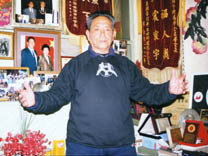
|
Feng
Zhiqiang performing one
of his Neigong (internal)
exercises
|
|
MR.FENG: Qi
is a kind of driving force (Dong
Li). For example blood circulation
can be explained with the term
"Qi". Internal styles
say: "exercise Intention
(Yi), not Qi", "when
you use Intention, your channels
will not be blocked", "exercise
Qi, not physical strength (Li);
when you exercise physical strength,
it will easily break";
"Intention should be focused
on Spirit (Shen), not Qi; when
it is focused on Qi, then Qi
will become stagnant".
There is also another saying
"Where Intention arrives,
Qi also arrives". However
one has to build Qi to reach
this level. Qi comes from food,
from breathing, it is also given
to us by our parents and stored
in the body as "Original
Qi" (Yuan Qi).
JS: You are well known as Chen
style Taijiquan expert, but
you also learnt Liuhe Xinyiquan.
Could you tell more about your
studies of this style?
MR.FENG: My Xinyiquan teacher,
Hu Yaozhen, was from Yuci in
Shanxi Province. His style was
of Wang Fuyuan's and Peng Tingjuan's
lineage. I was studying under
Hu's guidance for nine years.
Hu Yaozhen put great emphasis
on standing post exercises (Zhan
Zhuang). I learnt many standing
methods from him, not only San
Ti Shi, but also Embrasing Post
(Bao Zhuang), Closing Post (He
Zhuang), Even Post (Ping Zhuang)
and others. Each method had
to be practised for three years,
and while outside form did not
really change, the Intention
was changing. The teacher was
teaching different Intentions
to different students, it was
very individual, and the Intentions
were changing with the level
of the practitioner.
JS: Was it then something similar
to Yi Quan (Intention Boxing)?
MR.FENG: I do not know enough
about Yi Quan to be able to
compare the methods. Hu Yaozhen
did not teach standing methods
where palms were turned outwards
because in his opinion this
made Qi flow away.
JS: Is Qi related to Dantian?
MR.FENG:
Dantian is closely related
to movements of the waist.
In microscale it is the
center of the body - point
between belly button and
Mingmen, where Qi originates
from. In macroscale it
covers whole body. In
order to develop Dantian
one should start from
standing exercises and
collect and nourish Qi
- first focus Intention
on the center of the body.
Once the Qi in the body
becomes abundant, one
feels warm and movement
inside. Then Dantian breathing
should be used to induce
the outside movement of
the body with internal
movement. When Intention
and Qi are coordinated,
Dantian turns and Qi flows
freely in the whole body.
All parts of the body
move in a round way. This
is Hunyuan.
JS: "Hunyuan"
seems to be very important
idea as you decided to
add it to the name of
your system...
|
|
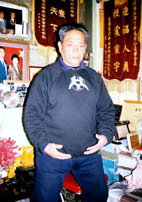 |
| |
Feng
Zhiqiang performing Low
Circle Hunyuan Post (Xiahuan
Hunyuan Zhuang)
|
MR.FENG: Heaven
and Earth are continuously revolving,
stars, the Sun, all of the heavenly
bodies spin and rotate. This
round, circular, coordinated
movement is called "Hunyuan".
This movement should also be
reflected in martial arts practice.
I learnt many martial arts and
walked a very crooked path before
I understood the core of Neijia
arts. I want to show other people
a straight, direct path to achieve
high skill. For this reason
I emphasize "Hunyuan"
and the function of Xinyi (Mind
and Intention).
(1)(2)(3)(4)
|


