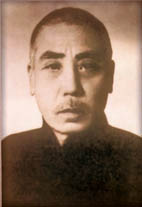
Chen had many students, including
Lei Muni, Tian Xiuchen, Feng Zhiqiang,
Hong Junsheng, Li Jingwu, Shen Jiazhen,
Gu Liuxin. Shen Jiazhen and Gu Liuxin
wrote a book called "Chen style
Taijiquan", which was published
in 1963. The drawings and explanations
for the first and second routines
of Chen style are based on Chen Fake's
and his son, Chen Zhaokui's photos
and introduce movements as taught
by Chen Fake in his late years. Note:
this book is a part of "The Complete
Book of Taijiquan" (T029B) which
is available through this site (Click
here!)
To read more about Chen Fake and
saw historical photos of him demonstrating
Chen Style Taijiquan .
In 1953 Capital Martial Arts Research
Society was established with Chen
Fake as its president and Hu Yaozhen
as vice-president. Feng Zhiqiang
was going there everyday, first
helping his teachers with everyday
chores, and then asking for guidance
and teachings. In this way he became
Chen Zhaokui's (Chen Fake's son)
practice partner. Most of Chen Fake's
disciples were afraid to practice
pushing hands with Chen Fake because
of pain, but Feng Zhiqiang treated
this as the best way to learn true
skill. Since Feng's gongfu brothers
always let Feng "enjoy"
this "pleasure", at Chen
Fake's late years it was usually
Feng Zhiqiang who dealt with strangers
coming to cross hands.
In his letter to Wan Wende of Shanghai,
Chen Zhaokui wrote: "I have
one older gongfu brother, his name
is Feng Zhiqiang, he's extremely
intelligent, and his skill is the
best among all our gongfu brothers".
At the age of thirty Feng was already
very proficient in both arts of
Xinyi and Taiji and became very
famous in Beijing martial arts circles.
After Chen Fake passed away in
1957, Feng Zhiqiang, although busy
with his work in electric appliances
factory, was keeping in touch with
his gongfu brothers and made few
simple rules to be observed by those
teaching martial arts: "first,
do not make trouble; second, do
not fight; third, if somebody comes
to challenge you, I (e.g. Feng Zhiqiang)
will deal with him". It happened
many times that either Feng or one
of his gongfu brothers was challenged
and Feng had to deal with the challenger.
Once a Qigong master wanted to compare
his skill of Bigu (fasting) with
Feng. The rule was to sit in meditation
for three days with some water as
the only food. After three days
Feng as usually went out to practise
with his 19kg steel rod, while Qigong
master could hardly walk!
Feng was in very good relations
with Chen Fake's son, Chen Zhaokui.
Before death Chen Fake asked Feng
to take care of Chen Zhaokui. Feng
was often practising together with
Chen Zhaokui, taking care and protecting
him. When Zhaokui passed away in
1981 at the age of 53, Feng was
very sad and was often saying that
he did not take good care of his
gongfu brother.
Chenjiagou
is the place where Chen style
Taijiquan comes from. Every
generation of the clan had
its masters, and in the 17th
generation the most skilfull
was Chen Fake. However, since
after his arrival to Beijing
Chen Fake was living in the
capital, Beijing became the
center of Chen style Taijiquan.
After the Cultural Revolution
(1966-1976) was over, Zhang
Weizhen, Communist Party secretary
of Chenjiagou, wrote a letter
to Feng Zhiqiang asking him
to come to Chenjiagou to teach
Taijiquan. Feng Zhiqiang visited
Chenjiagou three times, teaching
Taijiquan to the 19th generation
descendants of the style.
Many Taijiquan practitioners
of Chen clan from Chenjiagou
were also often coming to
Beijing to deepen their studies
with Feng. This part of the
history of Chen style Taijiquan
will always be recorded in
the chronicles.
|
|
|
| |
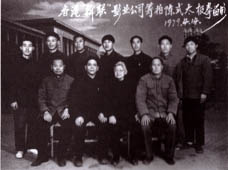
Feng
Zhiqiang in Chenjiagou in
1979
Sitting (from left): Feng
Zhiqiang (2nd), Chen Liqing
(3rd; Chen style Small Frame
expert); "Four Tigers"
are standing (from the right):
Chen Xiaowang (2nd), Zhu Tiancai
(3rd), Wang Xi'an (5th), Chen
Zhenglei (7th)
|
In 1981 Feng Zhiqiang was asked
by one of his friends from Beijing
PE Institute to meet a foreign martial
arts expert. The foreigner, skillful
in many Chinese and foreign combat
arts, came to China to look for
martial arts masters, and although
BPEI introduced him to many experts,
he was still not satisfied and asked
for meeting with Feng Zhiqiang.
Feng asked the foreigner to demonstrate
his martial art and found out that
although the man's upper part of
the body was very strong, the lower
one was without roots. Feng asked
the foreigner to hit him, and using
"scaring the up to get the
bottom" method (also called
"drawing into emptiness")
pushed the opponent flying on the
wall. Since the foreigner could
not understand what happened and
found out that he was not hurt,
he asked to try again and was defeated
again. Afterwards the foreigner
was full of respect towards Feng's
skill and took up Taijiquan study.
In 1981 Feng Zhiqiang retired and
in 1983 became the president of
the Beijing Chen style Taijiquan
Research Association established
the same year. Since 1981 Feng Zhiqiang
has been invited to take part in
many competitions in China, and
in 1984 for the first time went
abroad, to Japan, to teach Chen
style Taijiquan. Later Feng also
visited Mexico, USA, Singapore,
Denmark, Holland, France and Hongkong.
The country Feng visits most often
is Japan. Among his student there
are not only Taiji practitioners,
but also Karate, Judo and Aikido
experts. He has been challenged
there many times by local martial
artists and gained great respect.
Same situation happened in 1986
in the US and in 1988 in Singapore.
Feng Zhiqiang has many times been
invited to move abroad to stay and
teach Taijiquan, but he always refuses
saying: "My roots are in China".
He has also authored many books
and video tapes/CDs on Chen style
Taijiquan, like "Practical
Fighting of Taijiquan", "The
Essence of Chen Style Taijiquan",
"Hunyuan Method of Taijiquan",
"Silk Reeling Method of Chen
Style Taijiquan", "Twenty
Four Elbows of Chen Style Taiji",
"Chen Style Taiji Grappling
Methods", "Chen Style
Xinyi Hunyuan Taijiquan" and
many others.
Feng Zhiqiang often says: "It
is my greatest wish is to let Taijiquan
culture from China better benefit
the mankind!".
(1)(2)(3)(4)