PART
TWO - COMPILING TAIJIQUAN
In the middle
period of emperor Wanli (1573-1620;
his other name was Zhu Yijun)
Chenjiagou's Chen clan, counted
from the first ancestor, Chen
Bu, reached already ninth generation.
Just at this time, a shining
star on the sky of martial arts
was born among nine generation
descendants - it was Chen Wangting,
later famous for compiling Taijiquan.
3
Chen Wangting
(1600-1680) was also called
Qinting. His grandfather, Sigui,
held a position of Dianshi (Dianshi
was an official position established
during Yuan Dynasty (1271-1368)
and later kept during Ming Dynasty
as continuation of old tradition;
Dianshi was a low-rank official
under authority of county magistrate;
for many dynasties there was
a position of Wei who was responsible
for catching bandits, however
Ming Dynasty abolished Wei and
(...) Dianshi was responsible
for tax collecting; since again
during Qing Dynasty Dianshi
was mainly responsible for county
jail and police tasks, so Dianshi
was often referred to as Wei)
in Shaanxi Province Didao County
(in today's Gansu Province).
Chen Wangting's father, Fumin,
held a position of Zhengshilang
(well-educated person nominated
to official position through
imperial edict). Wangting was
the second of Fumin's four sons.
Chen Wangting
was very talented and diligent,
and studied hard since early
childhood, practicing martial
arts in the mornings and studying
literature in the evenings.
He not only received true transmission
of family boxing, stand out
of the common run, but was also
well acquainted in classics
of various traditional schools
of thought, had great learning.
When he grew up he became a
man well versed in both martial
arts and literature, exceptionally
skilful in boxing and weapons,
with extraordinary consummate
skill of Qinggong (Light Skill,
climbing high walls and walking
on roofs). In his youth he escorted
merchants' caravans in Shandong
Province and defeated crowds
of bandits; thieves and robbers
were trembling with fear on
hearing of his name. Since Chen
Wangting had red and solemn
face, long beard, used to ride
a dark horse and hold halberd,
his friends from martial arts
circles gave him a nickname
of "Second Master Guan"
(e.g. Guan Yu, a hero from a
novel "The Romance of Three
Kingdoms"). During the
reign of Ming Dynasty emperor
Chongzhen (1628-1644) Chen Wangting
was promoted by county magistrate
and was in charge of township
garrison.
At the end
of Ming Dynasty, Chen Wangting,
already a Xiangsheng (military
Xiucai, a person who passed
imperial examination at the
county level) went to the township
to participate in Wuju examinations
(imperial examination at the
provincial level). During the
examination his extraordinary
archery skill, "Phoenix
seizes the nest" (shooting
arrows one by one into the red
circle inside the target so
that each next one pushes out
and replaces the former one),
put out other participants.
However
since Chen killed a person
during the examination
he had to flee the examination
ground and went to Dengfeng
to join the leader of
peasant uprising Li Jiyu
and avoid misfortune.
Later
Chen Wangting went back
to his home village to
live in seclusion. After
the uprising was defeated
and Li Jiyu and his family
were sentenced to death,
one of Li's high-ranking
officers, Jiang Fa, disguised
himself and went to Chenjiagou
as a servant. In order
to deceive the outsiders,
everybody in Chenjiagou
was calling Jiang Fa "Jiang
Bashi" (Bashi was
in older times the name
for long-term and seasonal
laborers). Chen and Jiang
were publicly known as
master and servant, but
actually they were bosom
friends, everyday exchanging
boxing skills, ploughing
and teaching children.
There are many stories
that have been passed
up to now in Chenjiagou,
like "The heroes
from Yudai Mountains became
friends", "Chen
Wangting accepts Jiang
Fa as his brother",
"Master and disciple
from Mumenzhai demand
the cow", "Jiang
Fa puts down evil spirits
at Yanghaiwa".
|
|
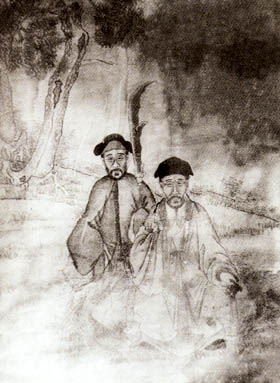 |
| |
Chen
Wangting and Jiang Fa
(holding the halberd)
|
It is worth
mentioning that since Jiang
Fa had certain contribution
when Chen Wangting was creating
Taijiquan and was Chen's good
friend and disciple, later Jiang
Fa's name was also recorded
in Taijiquan boxing manuals.
On the picture of Chen Wangting,
which is still kept in Chen
Family Shrine, Jiang Fa is the
person who stands behind Chen
and carries halberd. Chen Xinlan,
76-years old (the book was published
in 1992) lady from Chenjiagou,
tells the following story:
"I remember my grandfather
saying, there was a place called
Xiao Wu Chakou ("Crossing
of Five Little Roads")
on the way to South Zhangqiang
at the north-west of our village,
around that place there were
only old graves, eight poplars
grew there, the place was low-lying,
so people used to call it Yanghaiwa
(Sea Depression among Poplars).
There was a lot of trees there
and the place was overgrown
with weeds, very secluded, and
ghosts and goblins, demons and
monsters were appearing there
and harming people. No matter
if that was true or not, no
people dared to pass through
that place at night; even if
somebody had an urgent necessity,
he would still prefer to take
a longer way around. After Jiang
Fa passed away, since he did
not belong to the family and
could not be buried at the old
Chen clan cemetery, some people
suggested that he should be
buried at Xiao Wu Chakou. Since
Jiang Fa was very skillful at
martial arts and upright, he
certainly could put down wandering
souls. As a result, people from
the village burried Jiang Fa
at Xiao Wu Chaokou. It was really
strange, but since then the
whole place became peacefull
and quite. When I was a child
the grave was still there and
there was a stone tablet erected
in front of it. Grandfather
told me that this was the grave
of Jiang Bashi. Since I could
not read at that time, I do
not know what was written there.
The tablet was still there in
1958, later it disappeared.
When older brother Ziming was
still alive (Chen Ziming, ?-1951,
famous martial artist from Chenjiagou,
who wrote a book "Chen
Family Taijiquan Method passed
Through Generations") he
often pointed at the western
(two) rooms of Chen Wangting's
old courtyard and was telling
me: "Jiang Fa passed away
in these rooms". Only after
these two rooms collapsed they
were pulled down, about thirty
years ago; this is the courtyard
Chen Tang lives now. Although
Jiang Fa's grave was leveled
later, but I still remember
its approximate position."
(1)(2)
|


