Explanations
of Neigong (Internal Skill)
Principles
Taijiquan practice must
be conducted internally
and externally, Yin and
Yang must melt together
into one. If one wants
to achieve Internal Skill
(Nei Gong) of Taiji, one
must first grasp practice
methods conforming with
Taijiquan principles.
Principles and methods
of Internal Skill are
the only way to cultivate
Spirit (Shen), Intent
(Yi) and Qi; that's why
practice methods in traditional
Taijiquan not only pay
attention to movements
of body and hands, but
even more stress principles
and methods of Internal
Skill. Under any circumstances
they cannot be separated.
Many
students of Taijiquan
practice incorrectly -
first learn the routine,
and only after they are
skilled at it they explore
the principles; what they
do not understand is that
through this empty practice
without principles their
bodies already get used
to the incorrect way of
practice, stiff, inflexible,
with physical strength.
Once the students want
to explore the principles,
the way they move (with
stiff and inflexible strength)
already becomes habitual
and the problems are very
difficult to get rid of;
and although they practice
correctly for a long time
later, Internal Strength
(Nei Jin) is out of their
grasp and there is no
way that they can reach
deep understanding of
high skill levels.
My teacher
handed down a correct
method of teaching martial
arts - from the beginning
both movements and principles
are explained clearly,
with stress put on using
principles to guide the
movements correctly. The
principles of movements
have very explicit guiding
meaning, and only by following
the correct order of practice
handed down by old generations
of masters one can quickly
enter the correct path
and pursue more advanced
study.
Yang
Style Taijiquan emphasizes
internal and external
practice, every movement
and every posture should
contain a Method (Shu)
within, and the Method
must come out of the movements
and postures. Movements
and Method depend on each
other and complement each
other. One must not first
practice movements and
then learn the principles,
as well as one must not
first learn the principles
and then practice movements.
The beginner by imitating
(the teacher) will first
grasp the external movements,
but since the principles
of Internal Skill (Nei
Gong) cannot be seen,
it is not easy to understand
their essentials. Since
on the elementary level
Spirit (Shen), Intent
(Yi) and Qi are not ready
to accept assignments
coming from the mind (consciousness),
it is impossible to merge
movements and Methods
in one step. For this
reason students should
first of all attach importance
to the careful study of
the principles.
Every
movement and posture of
the boxing routine practice
should have, as the boxing
classics say, "Intent
in first place" (Yi
Zai Xian), Intention should
guide the form from the
beginning to the end,
one should not practice
"empty movements"
even for a short moment.
For example in the Commencing
Form, before the hands
raise and the movement
is born from utmost stillness,
Intention has already
started to control the
whole body so that all
its parts one by one have
been adjusted according
to the Internal Skill
principles.
When
the practice reaches the
intermediary level, there
are many principles, every
movement and posture have
one kind of fixed principles,
and the principles between
two movements may mutually
alternate and derive from
each other. On the high
level the accumulation
and changes of principles
appear naturally, without
thinking. My teacher once
said, during routine practice,
when movements and Methods
are harmoniously combined
so that they strictly
follow ones Intent, at
that moment a subtle and
profound (phenomena) may
develop. The whole body
is transparent and empty,
one forgets about oneself
and is non-active - this
high level starts from
learning to soften hands
and wrists. Every step
and every move should
be completely guided by
the principles of boxing
movements, and only later
one can gradually attain
the level of complete
relaxation, transparency
and emptiness.
For
this reason all those
who want to learn Taijiquan
should be warned to seriously
explore and understand
the principles of boxing
movements. Following are
chosen explanations of
the principles of boxing
movements; for the sake
of better explanation
(deeper impression), the
pictures show both correct
and incorrect movements
so that Taijiquan practitioner
will not go astray.
1.CROWN
OF THE HEAD SUSPENDED
(XUAN DING)
Concerning
"Crown of the head
suspended", boxing
manuals say "Emptiness
guides propping up strength"
(Xu Ling Ding Jin), "Top
of the head suspended"
(Ding Tou Xuan), "Baihui
pushes up" (Baihui
Shang Ding), etc.
My teacher
never mentioned the above
sayings; he only explained
secretly transmitted essential
"Back of the neck
rubs against the collar".
"Rub against"
means that back of the
neck is relaxed and straight,
and is lightly kept close
to the collar when slightly
turning. During the process
when the back of the neck
rubs against the collar,
cervical vertebra gradually
tends to become upright
and straight, and the
posture of the body will
also become centered and
upright; when one attains
the state when it is centered
and upright, in that short
moment all of a sudden
whole body will get "fixed"
- head will be centered,
Spirit clear and Qi refreshed,
relaxed and comfortable
as if nothing existed.
The feeling of relaxed
head can make one happy
and free of worry, and
this state of mind will
naturally influence the
facial expression showing
a slight smile; in this
way both the inside and
outside of the body will
be in peaceful, gentle
mood. Paying constant
attention to slightly
rub against the collar
with the back of the neck
will keep the Ren and
Du channels clear of obstructions,
and since when Qi flows
than blood moves, chronic
illnesses of insufficient
supply of blood to the
brain, neck aches and
blocked Yuzhen will be
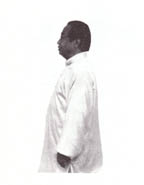
eliminated. (Ill.1)
|
|
|
| Ill.1:
CORRECT - back of
the neck kept close
to the collar |
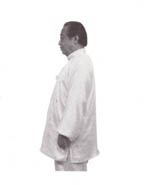
Ill.2:
WRONG - withdrawing
the chin on purpose
|
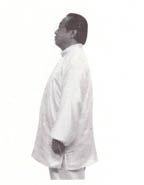
Ill.3:
WRONG - lifting
the head on purpose
|
If one
does not correctly understand
the relation between relaxed,
straight neck and upright
head, and does not realize
how harmful it is for
the postures and the body
when head is not upright,
then one will allow the
head to bend and lift
and this may turn into
a bad habit.
When
chin is withdrawn too
much, head bends down,
the front of the neck
is suppressed, breathing
is difficult, blood circulation
is not smooth, and as
a result one becomes apathetic
and dispirited. (Ill.2)
When
head is lifted then back
of the neck is suppressed,
Internal Qi can only circulate
between Jiabei and Weil¨¹
and cannot pass through
Yuzhen. When Three Gates
(San Guan) are not opened,
then one gets neck and
head aches, head swells,
which may even result
in vertigo. (Ill.3)
Only
when neck is relaxed and
straight, then head is
centered and upright,
at ease and comfortable,
which is a very important
part of the (Internal
Skill) principles.
(1)(2)(3)
|